

Edith Collier: Local Landscapes / 16 May 2026 – ongoing
Category
Current Exhibitions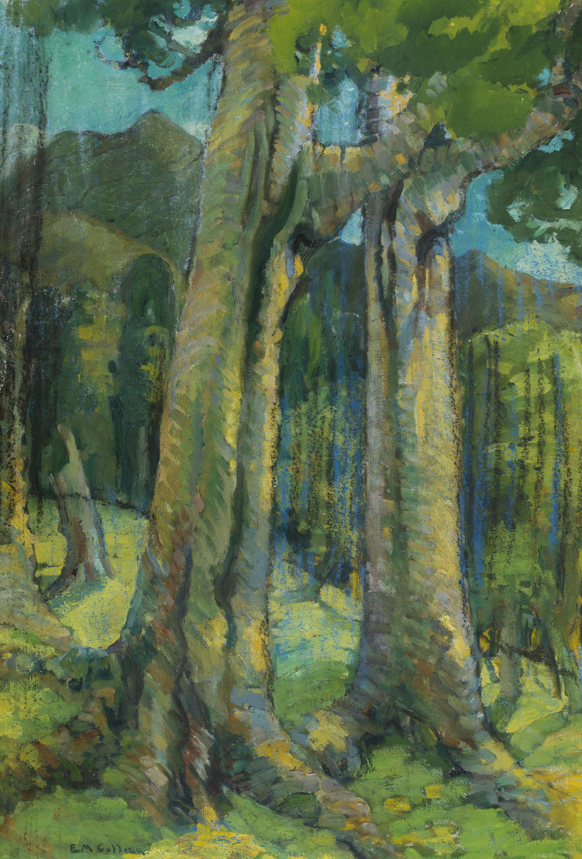
Edith Collier ‘Forest Sentinels’ circa 1922 – 1940, oil and crayon on board, 1/72. Collection of the Edith Collier Trust, in the permanent care of Te Whare o Rehua Sarjeant Gallery
Edith Collier: Local Landscapes
16 May 2026 – ongoing
Whanganui artist Edith Marion Collier (b.1885, d.1964) is now recognised as one of the earliest pioneers of modernism in Aotearoa New Zealand. After studying at the Wanganui Technical School of Art and Design, she headed to London, England in 1913 to further her art studies. Influenced and inspired by contemporary European art, her teachers Margaret Preston and Frances Hodgkins, and her group of like-minded artist friends there she produced her most avant-garde modernist works.
In 1922 Collier returned home to Whanganui and continued to paint and exhibit. Unfortunately the conservatism of New Zealand, so remote from exposure to the latest European art developments, combined with her fresh modernist aesthetic, meant her work was met with incomprehension. While Collier’s father Henry has been popularly vilified after he burned some of her paintings when his high hopes of her celebrated return were dashed, he was in fact a generous and successful businessman who financially supported his eldest daughter for an astonishing period of nearly nine years in Europe.
Henry Collier emigrated from Manchester, England in 1860. Henry and his brother Herbert were musicians and music teachers and established a music importing business, H. Collier & Co, with premises in Whanganui, Hawera, Stratford, New Plymouth, and Feilding. Henry married his pupil Eliza Catherine Parkes and they had ten children. Henry’s focus shifted to farming and he became a substantial landowner with properties within the Taranaki, Whanganui, and Rangitīkei regions. Unusually for the time, after his death in 1935, Henry Collier’s estate was divided among his daughters as well as his sons, and much of the land remains in family hands today.
Following on from the Sarjeant Gallery’s 2024–2025 exhibition Edith Collier: Early New Zealand Modernist, which is currently touring New Zealand, we are delighted to bring to light this group of works focusing on landscapes Collier produced after her return home while staying with her siblings at four of the family properties; Uplands, Maungaraupi, Wakarua and Mataitira. Providing a glimpse beyond her most iconic and well-known works, and drawn from the Edith Collier Trust, Sarjeant Gallery and family collections, this show includes rarely seen examples of her continued artistic experimentation.
Shortlisted for the Ockham New Zealand Book Awards in 2025 and published by Massey University Press, the Edith Collier Trust and the Sarjeant Gallery, Edith Collier: Early New Zealand Modernist is available to purchase at the Sarjeant Gallery shop.